Why Businesses Are Moving Beyond Tool-First AI Adoption
From AI Tools to Business Transformation

Introduction
Artificial intelligence has moved quickly from experimentation to everyday business use. Companies now have access to powerful chatbots, copilots, automation platforms, coding assistants, analytics systems, and AI agents. Yet simply giving employees access to more AI tools does not automatically create meaningful business value.
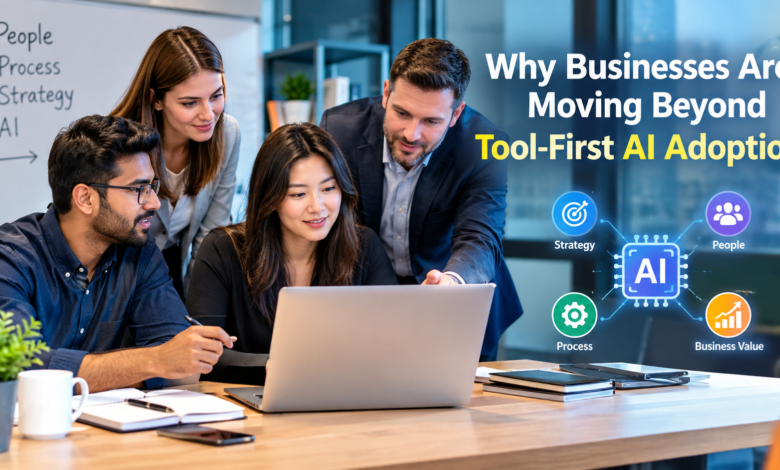
This is why Why Businesses Are Moving Beyond Tool-First AI Adoption has become an important business and technology question. The focus is shifting from which AI tool should we buy? to which business problem should we solve, and how should work change to solve it?
Recent research from McKinsey found that organizations creating greater value from AI are increasingly redesigning workflows, changing organizational practices, and building stronger AI governance rather than treating AI as another software deployment.
What Is Tool-First AI Adoption?
Tool-first adoption begins with technology.
A company discovers a new AI platform, purchases licenses, gives employees access, and encourages teams to experiment. Employees may use AI to summarize meetings, write emails, create presentations, analyze documents, generate code, or produce marketing content.
These applications can be useful. However, they often improve individual tasks without changing the wider process.
For example, an employee may use an AI assistant to prepare a report faster. But if that report still has to pass through the same slow approval process, manual data checks, and disconnected systems, the organization may gain only limited value.
The problem is not necessarily the AI tool. The issue is that the surrounding workflow has remained unchanged.
Why Businesses Are Looking Beyond Tools
One major reason is the growing pressure to demonstrate measurable returns from AI investments.
Deloitte’s 2026 enterprise AI research describes a gap between organizations adopting AI and organizations fundamentally reimagining how their businesses operate. Its research highlights work redesign, governance, infrastructure, data, and talent as important parts of the transformation challenge.
Businesses therefore have more questions than simply whether employees are using AI.
They want to know:
- Is AI reducing operational delays?
- Is customer service becoming more effective?
- Are employees spending less time on repetitive work?
- Is decision-making improving?
- Are costs falling or revenue opportunities increasing?
- Can AI be governed safely?
- Can the new workflow operate reliably at scale?
These questions move AI adoption from software purchasing toward business transformation.
Workflow Redesign Is Becoming Central
One of the strongest findings from recent AI research is the importance of changing workflows.
McKinsey’s 2025 global AI survey reported that workflow redesign had the strongest relationship among the organizational attributes it examined with achieving EBIT impact from generative AI. Only 21% of respondents using generative AI said their organizations had fundamentally redesigned at least some workflows.
This highlights an important distinction.
Adding AI to an existing process is not always the same as redesigning the process around AI.
Consider a customer-support operation. A tool-first approach might give agents an AI assistant that drafts responses. A transformation-oriented approach could examine the entire customer journey, including ticket classification, information retrieval, response generation, escalation, quality review, and follow-up.
The second approach asks how the complete workflow can operate differently.
AI Adoption Is Also About People
Technology cannot transform an organization by itself.
Employees need to understand how their responsibilities are changing, where AI should be used, when human judgment remains necessary, and how AI-generated work should be reviewed.
McKinsey’s recent research on AI readiness found that organizational readiness was more strongly associated with reported enterprise value capture than individual readiness alone. The research emphasizes workflow changes, leadership behavior, skills, culture, and change management.
This means training should go beyond teaching employees how to write better prompts.
Businesses increasingly need to teach people how to work differently with AI.
That can include reviewing AI outputs, identifying errors, handling sensitive information, supervising automated processes, interpreting AI recommendations, and knowing when human intervention is required.
Governance Cannot Be an Afterthought
As AI becomes embedded deeper into business operations, governance becomes more important.
An experimental chatbot used for brainstorming creates different risks from an AI system that influences financial decisions, customer eligibility, security operations, or business-critical processes.
Deloitte’s research has identified regulation and risk management among the significant barriers to scaling generative AI. Its 2025 research also emphasized governance, collaboration, and continuous iteration as important elements of sustainable AI value.
Businesses therefore need clear rules covering areas such as data access, privacy, security, model usage, human oversight, accountability, and monitoring.
The goal is not simply to restrict AI. Good governance helps organizations use it with greater clarity and control.
Measuring Outcomes Instead of Adoption
Another major change is the move from measuring AI activity to measuring business outcomes.
Counting the number of AI licenses purchased or employees using an AI assistant can show adoption, but it does not necessarily demonstrate value.
A stronger measurement approach looks at operational results.
For example, a company could measure:
Productivity
How much time is saved on repetitive activities?
Speed
Has the time required to complete a process decreased?
Quality
Are errors reduced or output quality improved?
Customer Experience
Are customers receiving faster or more useful service?
Financial Impact
Does AI contribute to measurable cost savings, revenue growth, or margin improvement?
This outcome-oriented approach makes it easier for leaders to determine which AI initiatives deserve further investment.
The Rise of AI Agents Changes the Question
The development of AI agents is also pushing businesses beyond simple tool adoption.
Traditional AI tools often assist a person with a particular task. AI agents can potentially coordinate multiple steps within a workflow, depending on their design and permissions.
This creates new opportunities but also introduces new responsibilities.
Deloitte reported in 2025 that organizations were increasingly exploring autonomous agents while governance and regulatory concerns remained important barriers.
As agents become more capable, businesses will need to think about permissions, monitoring, escalation, traceability, and human accountability.
The question becomes not simply, “Which AI assistant should employees use?” but “How should humans and AI systems work together across an entire business process?”
A More Strategic AI Adoption Model
Businesses moving beyond tool-first adoption can start with the problem rather than the technology.
A practical approach includes five stages:
1. Identify the business problem.
Find bottlenecks, repetitive work, customer pain points, or decision-making challenges.
2. Map the existing workflow.
Understand how work currently moves between people, systems, data, and approvals.
3. Determine where AI adds value.
AI should be introduced where its capabilities can improve the process rather than simply because a new tool is available.
4. Redesign the workflow.
Decide which activities should be automated, augmented, simplified, or retained as human responsibilities.
5. Measure and improve.
Track business outcomes, monitor risks, collect employee feedback, and continuously refine the system.
This approach can help organizations avoid scattered AI experiments that produce impressive demonstrations but limited operational impact.
What the Shift Means for the Future
The future of enterprise AI is unlikely to be defined only by the number of tools a company uses.
Instead, competitive differences may increasingly come from how effectively organizations redesign work around AI.
Recent McKinsey research describes leading organizations as those that focus AI on high-value areas, redesign workflows, and treat transformation as an organizational change effort rather than a technology deployment.
That does not mean AI tools are becoming less important. The tools remain the foundation of many AI initiatives. What is changing is the way businesses think about them.
The tool is no longer necessarily the starting point.
The business problem, workflow, people, governance, and measurable outcome are becoming equally important.
Conclusion
Why Businesses Are Moving Beyond Tool-First AI Adoption can be answered in one central idea: access to AI does not automatically create transformation.
Businesses are increasingly looking at the complete system surrounding the technology. They are examining workflows, employee responsibilities, data, governance, security, leadership, and measurable outcomes.
The next phase of enterprise AI will therefore be less about collecting AI tools and more about redesigning how organizations work.
Companies that approach AI as a business transformation challenge can better connect technology investment with practical operational goals. The real opportunity is not simply to use AI more often, but to rethink where AI can make work faster, smarter, safer, and more valuable.